


〒103-0025 東京都中央区日本橋茅場町1-1-6 小浦第一ビル2B >> MAP
Phone : 03-5542-1669
Open : Tue.-Sat. 12:00-19:00 日曜・月曜・祭日 休廊 Closed on Sun., Mon., National Holiday
Koura Bldg. Ⅰ-2B, 1-1-6, Nihombashi Kayabacho, Chuoh-ku, Tokyo 103-0025, JAPAN
phone : +81(0)3 5542 1669 e-mail : info@yuki-sis.com http://yuki-sis.com


























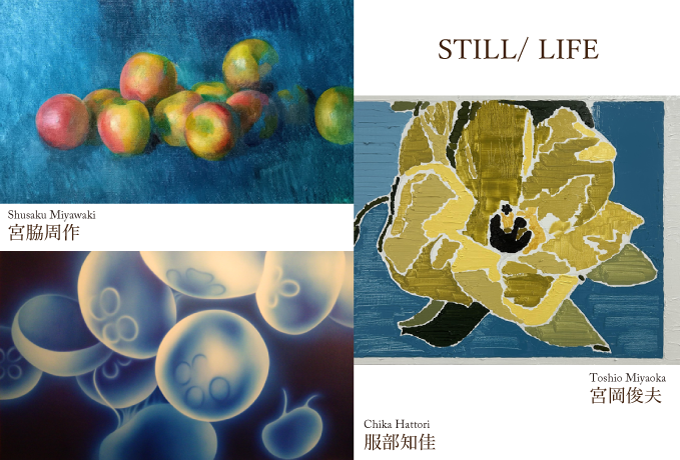
Shusaku Miyawaki Toshio Miyaoka Chika Hattori
宮脇周作 宮岡俊夫 服部知佳
STILL/ LIFE
2026.7.18(Sat)- 8.1(Sat)
日、月休廊 Closed on Sundays, Mondays
12:00~19:00
YUKI-SIS では、2026年7月18日(土)より、宮脇周作、宮岡俊夫、服部知佳の3名の作家による展覧会、「STILL / LIFE」を開催いたします。
今回の展覧会でご紹介する作家は宮脇周作、宮岡俊夫、服部知佳、の3人です。彼らは油彩、キャンバスという同じ技法で制作していますが、それぞれが異なるモチーフへのアプローチの仕方を試みています。そのモチーフは、[STILL / LIFE]。
俗にいう静物ですが、今回は生物も含めた意味で「静と生」をテーマに作家を選出致しました。
YUKI-SIS is pleased to present STILL / LIFE, a group exhibition featuring Shusaku Miyawaki, Toshio Miyaoka, and Chika Hattori, on view from Saturday, July 18, 2026.
Although all three artists work with the same medium—oil on canvas—each approaches the motif from a distinctly different perspective. The exhibition centers on the theme of STILL / LIFE. While still life conventionally refers to the depiction of inanimate objects, this exhibition expands the term to encompass living beings as well, exploring the dual meanings of stillness and life. The participating artists have been selected for the unique ways in which their practices engage with these intertwined ideas.
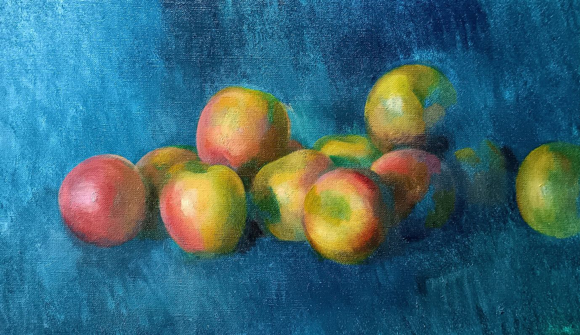
宮脇周作 12個のりんご 455x273 (M8)油彩、キャンバス 2026
宮脇 周作 Shusaku MIYAWAKI
1980年福岡県生まれ。 2003年成安造形大学造形学部デザイン科イラストレーション群イラストレーションクラス卒業。
現在は、東京在住。日本テレビの法廷画家として活動しながら、自身の作品を制作しています
Born in 1980 in Fukuoka Prefecture. Graduated from Seian University of Art and Design, Department of Design, Illustration Group Illustration Class in 2003. Currently resides in Tokyo. Works as a court painter for Nihon Television while creating his own artwork.
宮脇は被写体を10秒見つめると、その姿を忠実に絵に再現できるといいます。その特殊な力は、その形や色などを瞬時につかみ取る能力だけでなく、そのものが持つ「気」を感じ取る能力が非常に優れている彼の特質によるものです。法廷画家として活躍する彼は、注目度が高い裁判では数秒しか着席しつづけることができないといいますが、しかし、そこに「存在したこと」の空気を鉛筆で短い時間に紙に残さなければなりません(法廷では鉛筆しか持ち込むことができないので、法廷の外で着色するそう)。わずかな人の表情の差や視線など、彼が短い間に気づく能力は、私たちが想像しえないほどのものです。
Miyawaki says that after observing a subject for just ten seconds, he is able to reproduce their likeness with remarkable accuracy. This extraordinary ability stems not only from his capacity to instantly grasp a subject's form, color, and other visual characteristics, but also from his exceptional sensitivity to perceiving the ki—the vital presence or energy—that each subject possesses.
As a courtroom sketch artist, Miyawaki often covers high-profile trials, where he may be allowed to remain seated for only a matter of seconds. Yet within that brief moment, he must capture, in pencil, the atmosphere of having been there—the very sense of the subject's presence—on paper. (Because only pencils are permitted inside the courtroom, the sketches are colored later, outside the courtroom.)
His ability to notice the slightest changes in a person's facial expression, the direction of a gaze, and countless other subtle details within such a short span of time is far beyond what most of us can imagine.
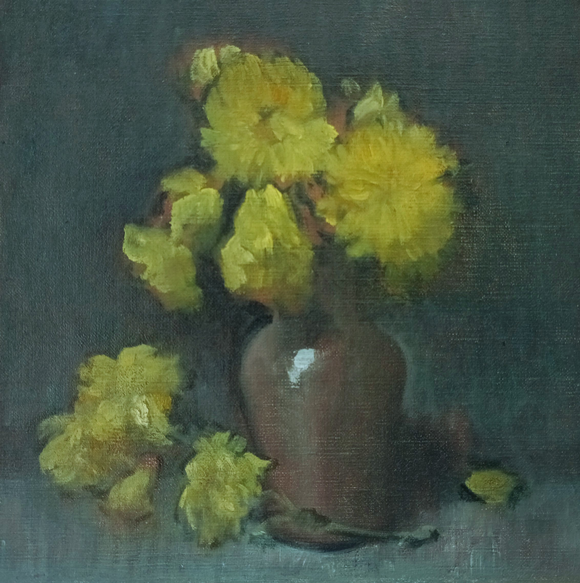
宮脇周作 洋キクA 273x273 (S3) 油彩、キャンバス 2024
そんな彼が描く静物画は、花や果実などをモチーフとして描かれます。彼はまた写真を一切とらず、作品を描き終えるまでの時間を実際にモチーフを目の前にして過ごします。
つまり、彼の作品には、彼のそのモチーフを見つめながら描く時間70~100時間、すなわち2~3週間分の時間が閉じ込められているということになります。
花はやがてしおれてその花弁を落とし、果実はその実を傷めていきます。そのモチーフのわずかな変化や息づかい、その瞬間の連続を宮脇は真摯にキャンバスに映しとっていきます。
In contrast, Miyawaki's still-life paintings take flowers and fruit as their primary motifs. He never works from photographs. Instead, he remains in the presence of the subject throughout the entire process of painting, observing it directly until the work is complete.
Each painting thus becomes a repository of the seventy to one hundred hours—roughly two to three weeks—that he spends in sustained dialogue with its motif.
Over that time, flowers gradually wilt and shed their petals, while fruit ripens, bruises, and slowly begins to decay. Miyawaki attentively records these subtle transformations, capturing not only the visible changes but also the quiet rhythm of life unfolding before him. His paintings preserve an accumulation of fleeting moments, inviting viewers to experience the passage of time as something tangible upon the canvas.
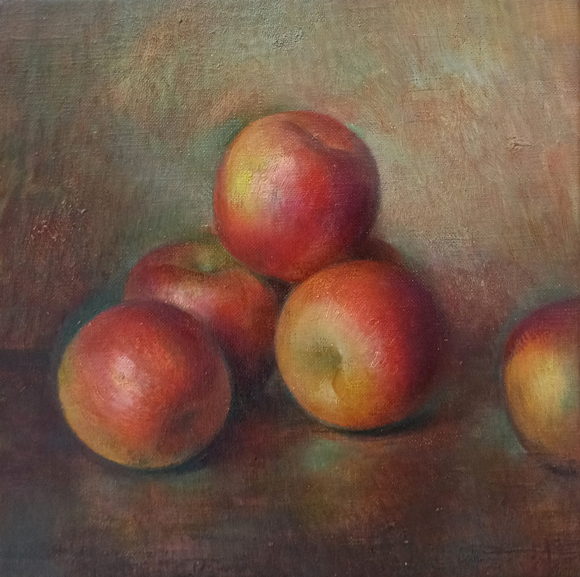
宮脇周作 6つのりんご 273x273 (S3) 油彩、キャンバス 2026
彼の作品にはどこか「死への畏敬の念」を感じます。「法廷では命の重さをいつも感じる」と宮脇は話します。ひとつの命が亡くなることで、こんなにも悲しみや憎悪、強い感情がおこる「命」という存在を、いつも法廷で感じている彼だからこそ、静物のもつ生にも同じ気持ちで臨み、より時間をかけ見つめることでその生を絵に残すこと。最近ようやく、その変化を残すことに自分のテクニックが追い付いてきた、と話します。
「普段の人や風景は、変化が速すぎて、全てを作品に封じ込めることが難しい。だから動かずにただそこにいてくれる静物に惹かれるのです」
花や果物が確かに目の前にあった(いまはもうない)感が絵にでてくれたら、と思って描いているという。
There is, perhaps, an unmistakable sense of reverence in Miyawaki's paintings—a quiet awareness of mortality. "In the courtroom, I am constantly confronted with the weight of life," he reflects. Witnessing how the loss of a single life can give rise to profound grief, anger, and countless other emotions has made him acutely conscious of the significance of life itself. It is with that same attentiveness that he approaches the living presence of flowers and fruit, spending weeks observing them so that their vitality—and its gradual transformation—may be preserved on the canvas. Only recently, he says, has his technique begun to match his desire to capture those subtle changes.
"People and landscapes change too quickly. It is impossible to contain everything they are within a single painting. That is why I am drawn to still life—subjects that simply remain there before me."
Miyawaki explains that he hopes his paintings will convey the unmistakable feeling that the flowers and fruit once truly existed before him—even though they are no longer there. In this way, each work becomes not merely a depiction of its subject, but a quiet record of a life that has passed through time.
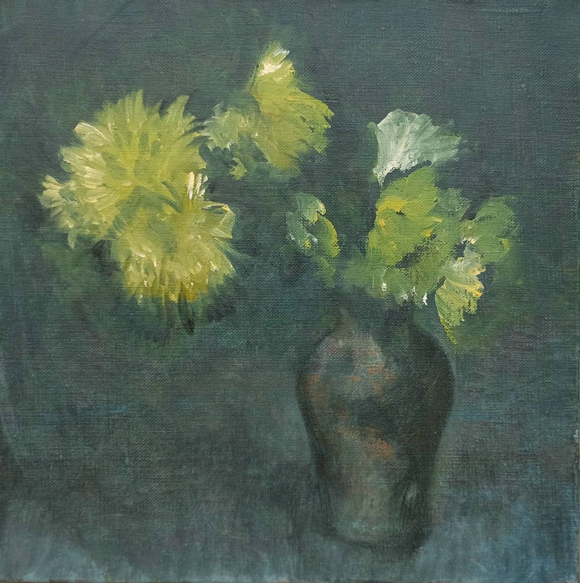
宮脇周作 洋キクB 273x273 S3 油彩、キャンバス 2024
【Artist Note】
普段は油彩でりんごや花を何度も繰り返し描くことが多いです。
写真は使わず目の前にあるモチーフを枯れるまで、朽ちるまで描き込んでいきます。
描いては消し、描いては消しの反復で生まれた思考の痕跡のようなものも調子(濃淡)とした画肌になっていきます。
基本的にはりんごなどのモチーフにグッとフォーカスしていますので、意識のいっていないところは流し描き込まず省略することが多く背景やモチーフ台は曖昧になっています。
長年同じようなモチーフ(静物)を描き続けたポール・セザンヌやジョルジョ・モランディが昔から好きです。
この数年は色に興味をもち、画面の色彩は徐々に豊かになってきていると思います。(昔から使っている絵具の種類はほぼかわらないのですが)
今回の作品も半分がりんごの絵になっています。見ているりんごは子供の頃から変わらないのですが、私の見方や考え方、画家としての経験値によって画面がどんどん変化、進化していく感じが面白く思うところです。
りんごのかたちや色は単純に好きです。
それとりんごをよく描く理由は、私は1枚の絵を描くのにだいたい3週間ほど(70時間~100時間)くらいかかります。
りんごが丁度、3週間ほどで腐ってしまいます。りんごが朽ちる時間と絵が仕上がる時間が同じということになります。
これもりんごを繰り返し描いてこれている理由のひとつだと思います。
その3週間の時間を1つの画面に定点カメラのように定着させていきます。
元気な頃のりんごと朽ちていくりんごが画面の中でグラデーションになっていきます。自然光で描くことも多く、朝方の光と夕方の光、晴れの日雨の日の光も1つの画面にミックスされたりもします。
種類にもよりますが、花はどうしても1週間もたないので早描きになります。
いずれにせよ、繰り返し同じモノを描きますが、気をつけていることは「何度みてもはじめて対峙したような、そしてもう二度と見れないかもしれない」そんな気持ちで日々描いています。
かたちあるものはいつか朽ちたり壊れたりなくなったりするもので、その儚さや虚しさを表現しているところもあります。
先日もお話ししました、直接的な表現はしませんが毎週裁判所で見聞きする、凄惨な事件や事故にたいする鎮魂(祈り)の意味合いも少しあるように思えます。
何か心の中にわいてくるザラッとした嫌な感じも素直に画面に出すようにしています。静物画にも色んな思いを込めてえがけます。
宮脇 周作
[Artist Note]
I often return to the same motifs—apples and flowers—painting them over and over again in oil.
I never work from photographs. Instead, I paint directly from life, remaining with the subject until it withers or decays. Throughout the process, I repeatedly paint and erase, paint and erase. The traces of that sustained dialogue—the record of my thinking—gradually become part of the painting's surface, emerging as subtle shifts of tone and texture.
My attention is intensely focused on the motif itself. Areas that fall outside that concentration are often left only loosely described or omitted altogether, which is why the backgrounds and supporting surfaces tend to remain ambiguous.
I have long admired artists such as Paul Cézanne and Giorgio Morandi, who devoted themselves to painting similar still-life subjects throughout their careers.
Over the past several years, I have become increasingly interested in color, and I feel that the palette of my paintings has gradually grown richer, even though the paints I use have remained almost exactly the same.
About half of the works in this exhibition depict apples. The apples themselves have not changed since I first began observing them as a child, yet my way of seeing, my way of thinking, and my experience as a painter continue to evolve. It is fascinating to me that the paintings themselves keep changing and developing in response. I also simply love the form and color of apples.
There is another reason why I paint apples so often. A single painting usually takes me around three weeks—between seventy and one hundred hours—to complete. By that time, an apple has typically begun to decay. In other words, the time it takes for the apple to perish coincides with the time it takes for the painting to come into being. I believe this is one of the reasons I have continued to return to apples as a motif.
Over those three weeks, I attempt to preserve the passage of time within a single canvas, almost like a fixed camera recording one continuous scene. The apple in its freshness and the apple in its gradual decay coexist, forming a quiet continuum within the painting. Because I often work in natural light, the changing light of morning and evening, of sunny and rainy days, is also accumulated within a single image.
Flowers, depending on the variety, rarely last even a week, so they require a much faster approach.
No matter how many times I paint the same subject, I try to approach it each day as though I were encountering it for the very first time—and perhaps for the last time as well.
Everything that has form will one day wither, break, or disappear. My paintings are, in part, an attempt to express that fragility and transience. As I mentioned before, although I do not address them directly, they also carry something of a prayer for those affected by the tragic crimes and accidents that I witness each week through my work at the courthouse. I try to allow the uneasy, abrasive feelings that arise within me to surface honestly in the paintings. Even a still life can hold many different layers of thought and emotion.
Shusaku Miyawaki
宮脇 周作 Shusaku MIYAWAKI
- 1980
- 福岡県生まれ
- 2002
- 「京都同時代ギャラリー グループ展
- 2003
- 「成安造形大学造形学部デザイン科
イラストレーション群イラストレーションクラス卒業 - 2003
- EPSONピエゾグラフギャラリー京都 Mixed-Media展
- 2007
- (京都・さるぅ屋Cafe 第一回個展
- 2008
- 京都・さるぅ屋Cafe 第二回個展
- 2015
- 東京新宿・花園画廊 油彩画個展
- 2018
- 東京銀座・ギャラリー枝香庵 油彩画個展
- 2019
- 東京日本橋・GalleryYUKI-SIS 「Still Life」グループ展
- 2022
- 東京銀座・OギャラリーUP・S 油彩画個展
- 2023
- 東京日本橋茅場町・GalleryYUKI-SIS 「Still Life – 静かな いのち –」二人展
- 2025
- 沖縄・平敷兼七gallery 「Postcard size Exhibition vol.4」グループ展
- 沖縄・act201 二人展
- 2010~
- 日本テレビ専属法廷画家
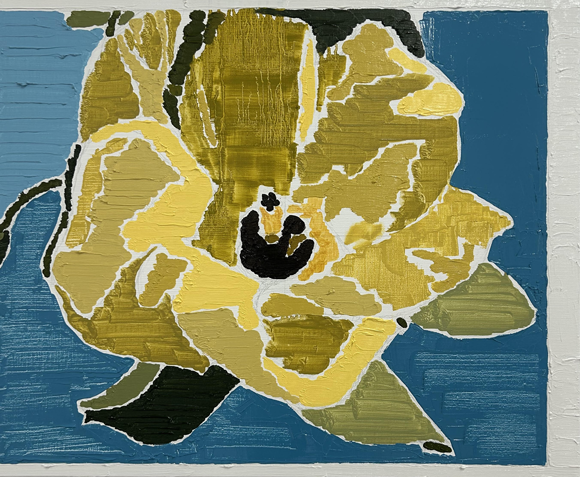
宮岡俊夫 A flower 50×60.5cm 油彩、カンヴァス 2026
宮岡 俊夫 Toshio MIYAOKA
宮岡俊夫は1984年島根県出雲市生まれ。2008年多摩美術大学美術研究科修了。東京、京都とアトリエを移したあと、現在は活動の場を島根県出雲市に移し制作活動を続けています。
Toshio Miyaoka was born in Izumo, Shimane Prefecture, in 1984. He completed the Master's Program in Fine Arts at Tama Art University in 2008. After relocating his studio from Tokyo to Kyoto, he has now returned to his hometown of Izumo, Shimane Prefecture, where he continues his artistic practice.
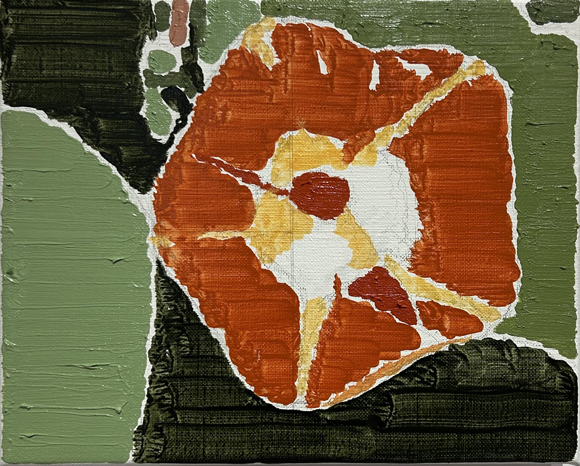
宮岡俊夫 A flower 22×27cm 油彩、カンヴァス、裏:新聞、コラージュ 2026
宮岡の制作方法はとてもユニークです。キャンバスの裏には、その絵のモチーフとなった、小さな切手大の写真の切抜きが貼ってあります。彼は、そのサイズの雑誌等の切抜きを見ながら描いていきますが、その時その切抜きは逆さまにしながら、その形と色をキャンバスに映しとっていきます。逆さまになったその切手サイズの切抜きからは、何が写っているのか詳細はわかりません。つまり、宮岡は、何を描くのか、対象物への一切の先入観を自分から排除し、その形と色、光を描くことだけにフォーカスして作品を描き上げていきます。
逆さまに描かれた作品は描き終わると、生の位置に戻されて完成となります。
Miyaoka's working process is remarkably distinctive. Affixed to the back of each canvas is a small image—roughly the size of a postage stamp—clipped from a magazine or other printed source. This tiny clipping serves as the painting's motif.
As he paints, Miyaoka works from the image turned upside down, carefully translating its shapes, colors, and light onto the canvas. At such a small scale and in an inverted orientation, the subject itself is no longer readily recognizable. By deliberately removing any immediate understanding of what he is depicting, he frees himself from preconceived ideas about the object, allowing him to focus solely on its formal qualities—shape, color, and light.
Only after the painting is completed is the canvas turned upright, revealing the finished image in its intended orientation.
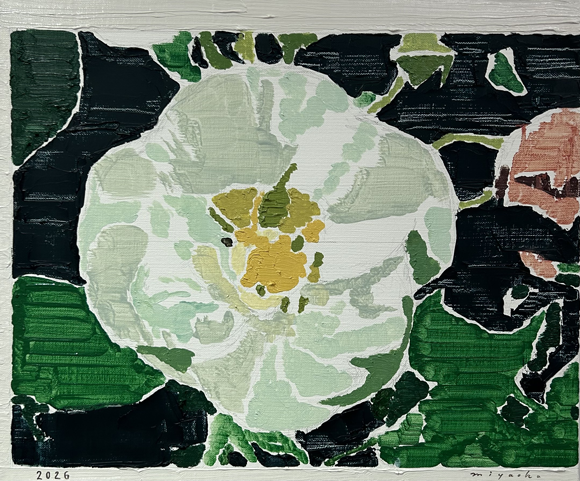
宮岡俊夫 A flower 38×45.5cm 油彩、カンヴァス、裏面:新聞、コラージュ 2026
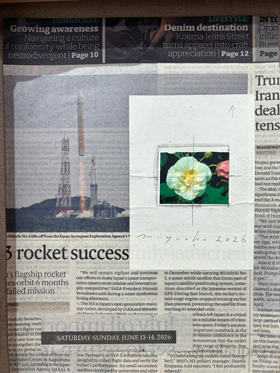
キャンバス裏面
彼が絵画を描く上で試みているのは、この世の全ての風景や事象を「逆さまに描くモチーフにする」ということで、その存在を一旦「名もない匿名の存在」に変換し、結果的にアウトプットしてみること。
私たちは普段すべての事象について「これは〇〇である」という常識や存在理由、社会的な立場など、自分では知らずに刷り込まれていることがあります。同じものを見つめているが、それを一度思い込みのない状態で見つめて描いた時、そこになにが写っているのか。これが宮岡が絵画において試していることです。
宮岡は風景や、歴史的な事象などを描きつつも「花は、僕のスタイルの作品においてとても向いているモチーフだと思います」と語ります。
彼の作品には、どこかこわばり、ひっかかる感覚と新しい魅力を感じます。そしてそれは私たちの普段のなにげない視点をも根本的に問いただすような経験です。
At the core of Miyaoka's practice is an attempt to treat every image—whether a landscape, an object, or a historical event—as a motif to be painted upside down. By doing so, he temporarily strips the subject of its identity, transforming it into an anonymous presence before reconstructing it as a painting.
In everyday life, our perception is unconsciously shaped by assumptions: we immediately identify what we see, assigning names, meanings, functions, and social contexts to it. Miyaoka asks what might emerge if those preconceptions are suspended—if we were to look at the same subject with fresh eyes, free from habitual recognition, and paint only what is actually seen. This is the central proposition of his painting practice.
Although Miyaoka has depicted subjects ranging from landscapes to historical events, he remarks, "Flowers are particularly well suited to the kind of paintings I make."
His paintings possess a subtle sense of tension—something at once unfamiliar and quietly compelling. They invite viewers to reconsider not only the subjects before them, but also the very habits of perception through which we encounter the world.
宮岡 俊夫 Toshio MIYAOKA
- 1984年
- 島根県出雲市生まれ
- 2006年
- 多摩美術大学絵画科油画専攻卒業
- 2008年
- 多摩美術大学美術研究科絵画専攻修了
主な個展
- 2014年
- 誰も知らない場所 ベイスギャラリー(東京)
- 記憶の外側で トーキョーワンダーサイト渋谷 (東京)
- 2016年
- 名前を奪われた風景 KUNST ARZT (京都)
- 2018年
- 何処か 私に 似ている KUNST ARZT (京都)
- 2020年
- 漂流する絵画 GAMOYON Gallery (大阪)
- 漂流する絵画 YUKI-SIS (東京)
- 2021年
- 月光-風景 DOOR gallery (松江)
- 記憶の痕跡 日本橋三越本店美術サロン (東京)
- 天皇-精神の焼跡- KUNST ARZT (京都)
- 2022年
- 月光-風景Ⅱ DOOR gallery (松江)
- 2023年
- 反転した絵画 もう一つの風景 YUKI-SIS (東京)
- 2025年
- それから YUKI-SIS (東京)
主なグループ展
- 2016年
- 第2回「藝文京展2016」入選作品展 京都芸術センター(京都)
- 日韓藝術通信 京都嵯峨芸術大学付属ギャラリー (京都)
- 2017年
- FACE展2017損保ジャパン日本興亜美術賞展 損保ジャパン日本興亜美術館(東京)
- 韓日藝術通信 Part2 忠清文化芸術会館 (清州、韓国)
- 2018年
- 風景の澱みから 井上光太郎・奈良田晃冶・宮岡俊夫展 2kwギャラリー(大津)
- ASK-7人の作家 ART OFFICE OZASA (京都)
- 2019年
- STILL LIFE 静物展 YUKI-SIS (東京)
- 揺れる記憶 カッシーナ・イクスシー青山本店アートギャラリーDELL’ARTE (東京)
- The Super Dupers-妄想をカタチに変えたアーティストたち- スパイラルガーデン (東京)
- 2020年
- 韓日藝術通信5「温度~往復書簡~」 忠北文化館森ギャラリー (清州、韓国)
- 2021年
- 日韓藝術通信5「温度~往復書簡~」 The Terminal Kyoto (京都)
- コンテンポラリーへの扉 日本橋三越本店 本館7階催事場 (東京)
- 2022年
- YUKI-SIS10周年記念展 YUKI-SIS (東京)
- 日韓藝術通信7~Gift~ OHARANO STUDIO GALLERY (京都)
- 2023年
- 岩佐昌昭宮岡俊夫2人展「陰影の愉しみ」 一畑百貨店5階美術サロン(松江)
賞歴
- 2014年
- 第29回ホルベインスカラシップ奨学生
- 2016年
- 藝文京展2016 入選
- 2017年
- FACE展2017損保ジャパン日本興亜美術賞展 読売新聞社賞
- 2004
- 多摩美術大学絵画学科版画専攻卒業
- 2005
- 個展/ギャラリー椿GT2 (東京)
- 第6回高知国際版画トリエンナーレ/いの町紙の博物館(高知)
- KIAF(Korealnternational Art Fair) / COEX (ソウル)
- 2006
- 個展/ギャラリー椿(東京)
- 「素材と表現」/東京オペラシティアートギャラリー(東京)
- 2007
- ACAF(Asia Contemporary Art Fair) / Pi部S92.94 (ニューヨーク)
- Artin Dojima/堂島ホテル(大阪)
- 2008
- 個展/ギャラリー椿(東京)
- 「Netwo「k Project J叩日n」/ interalia Art Company (ソウル)
- 「SPOT Japanese Contemporary Art」/ Gallery IHN (ソウル)
- KIAF(Korea international Art Fair/ COEX (ソウル)
- 2009
- 「Naoko KADOKURA Chika HATTORI / SP Gallery (ソウル)
- The Other Land」/ LEEAHN Gallery (大邱)
- KIAF(Korea International Art Fair) / COEX (ソウル)
- Daegu Art Fair/ EXCO (大邱)
- 2010
- 個展/ギャラリー椿(東京)
- Print Composition2010 /多摩美術大学美術館(東京)
- 京都アートフェア/ホテルモントレー京都(京都)
- PLUS東京コンテンボラリーアートフェア/東美アートフォーラム(東京)
- Asia Top Gallery Art Fair / Mandarin Oriental Hong Kong (香港)
- KIAF(Korea International Art Fair) / COEX (ソウル)
- ARTTAIPEI /Taipei WorldTrade Center (台北)
- ASYAAF / Sunshine University (ソウル)
- 2011
- 「寺田コレクションの若手作家たち」/東京オペラシティアートギャラリー(東京)
- ART OSAKA / GRANVIA OSAKA (大阪)
- ARTTAIPEI /Taipei World Trade Center (台北)
- Daegu Art Fair / EXCO (大邱)
- Young Art Taipei/Sun world Dynasty (台北)
- 2012
- 個展「in the blue hour] /ギャラリー椿(東京)
- Asia Top Gallery Art Fair / Mandarin Oriental Hong Kong (香港)
- ARTTAIPEI /Taipei World Trade Center (台北)
- Daegu Art Fair / EXCO (大邱)
- Young Art Taipei / Sheraton Hotel (台北)
- ART SHOW BUSAN / BEXCO (釜山)
- 2013
- 個展「wakeful night」/ Yoshiaki Inoue Gallery (大阪)
- 「自然の表現 わが山河part Ⅳ」/東京オペラシティアートギャラリー(東京)
- Daegu Art Fair / EXCO (大邱)
- 2014
- 個展「strawberry cocktail] /ギャラリー椿(東京)
- 「Do You see Me?」/Aki Gallery (台北)
- KIAF(Korea International Art Fair) / COEX (ソウル)
- 2015
- 個展「silence of the sea」/Art Gallery M84 (東京)
- 「現代作家によるクレバス画展」/サクラアートミュージアム(大阪)
- 「木を彫る」/東京オペラシティアートギャラリー(東京)
- ART SHOW BUSAN / BEXCO (釜山)
- 2017
- 個展「Parallel world」/ギャラリー椿(東京)
- KIAF(Korea International Art Fair) / COEX (ソウル)
- 2018
- 「巨匠たちのクレバス画展」/損保ジャパン日本興亜美術館(東京)
- KIAF(Korea International Art Fair) / COEX (ソウル)
- 2019
- 個展/ギャラリー椿(東京)
- 「木版画の魅力」/東京オペラシティアートギャラリー(東京)
- ART in PARKHOTELTOKYO/ParkHotel Tokyo (東京)
- KIAF(Korea International Art Fair) / COEX (ソウル)
- 2021
- 個展「my room becomes the sea」 /ギャラリー椿(東京)
- 「寺田小太郎いのちの記録」/多摩美術大学美術館(東京)
- 2022
- 個展「Lux·光」/ギャラリー椿(東京)
- 個展/ soohoh Gallery (ソウル)
- 2023
- 個展「Swim slowly 」/ ギャラリー椿 (東京)
- SEATTLE ART FAIR ( Lumen Field Event Center/ Seattle, US)
- Christmas Art Market / Spiral garden (東京)
- 2024
- BOTANICA / Bunkamura gallery(東京)
- SEATTLE ART FAIR ( Lumen Field Event Center/ Seattle, US)
- 2025
- 個展「絵空」/ ギャラリー椿 (東京)
- POSITIONS Berlin(Tempelhof Hanger/ Berlin, Germany)
- KIAF(Korea International Art Fair) / COEX (ソウル)
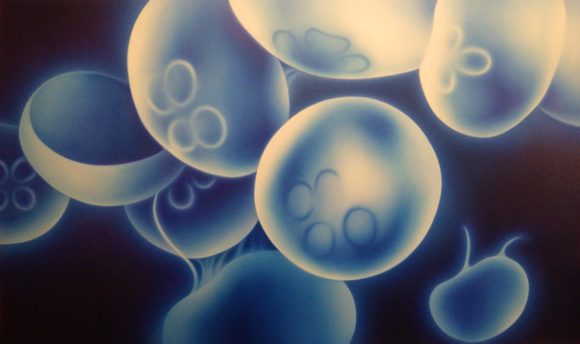
服部知佳 planets 1620x970 (M100) 油彩、キャンバス 2025
服部 知佳 Chika HATTORI
服部知佳は1981年東京生まれ。幼少期より油絵を習いますが、多摩美術大学では木版画を専攻。大学院中に、京橋の老舗ギャラリー「ギャラリー椿」にて初個展を開催。その時、大コレクションを持つ「寺田小太郎氏」に見初められ、オペラシテギャラリーのコレクションとなる。
その後も定期的にギャラリー椿で個展開催、海外アートフェア、美術館でのグループ展等、発表多数。
Chika Hattori was born in Tokyo in 1981. She began studying oil painting as a child, but later specialized in woodblock printmaking at Tama Art University. While still in graduate school, she held her first solo exhibition at Gallery Tsubaki, a long-established gallery in Tokyo's Kyobashi district. There, her work caught the attention of the renowned collector Kotaro Terada, whose acquisition of her work led to its inclusion in the collection of the Opéra City Gallery.
Since then, Hattori has presented regular solo exhibitions at Gallery Tsubaki and has participated extensively in international art fairs and museum group exhibitions, among many other presentations of her work.
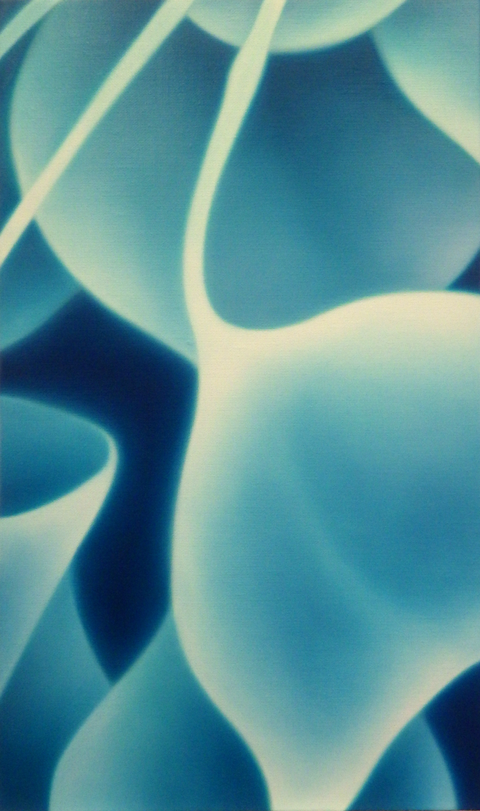
服部知佳 moonjade 455x273mm(M8)油彩、キャンバス 2026
服部知佳は、花や海洋生物などを主題とし、自身で撮影した写真をもとに作品を制作しています。その制作において特徴的なのは、大胆なトリミングと、対象を大きくクローズアップした視点です。自然の一部を切り取り、私たちの視線をそこへ集中させることで、普段は見過ごしてしまう生命のかたちや色彩、模様の豊かさをあらためて発見させてくれます。
服部はこう語ります。「この世界には、あらゆる面でとても個性的な色や形を持つ生き物がたくさんいます。私は絵を通して、その存在や、それぞれの個が持つ特性に気づいてほしいのです。」
私たちは、そうした生き物の存在をテレビや図鑑などを通して知っているかもしれません。しかし、服部の作品の中では、それらは実際の大きさを超えて拡大され、繊細な色彩とともに描き出されることで、まるで初めて目にする存在のように立ち現れます。花びらの微細な表情や海洋生物の複雑な紋様は、日常の視線では気づくことのない美しさを私たちに見せてくれます。そして、それぞれの生き物は与えられた姿をただ受け入れ、静かに、力強く、その生を全うしていることに思い至らせます。
何層にも重ねられた透明感のある絵具によって生み出される豊かな色彩のグラデーションは、輪郭をやわらかく溶かし、画面にしなやかな動きと呼吸するような広がりをもたらしています。その空間は、描かれた対象だけでなく、その周囲に広がる気配や空気までも感じさせます。
Chika Hattori's paintings are centered on motifs such as flowers and marine life, often based on photographs she has taken herself. A defining characteristic of her practice is her use of bold cropping and dramatically enlarged perspectives. By isolating fragments of the natural world and directing the viewer's gaze toward them, she reveals the richness of forms, colors, and patterns that often escape our everyday attention.
As Hattori explains, "The world is filled with living creatures whose colors and forms are remarkably unique. Through my paintings, I hope people will become aware of their presence and of the individuality that each one possesses."
Many of these creatures are familiar to us through television, books, or natural history guides. Yet in Hattori's paintings, they appear at a scale far beyond their actual size, rendered with extraordinary delicacy and depth of color. Seen in this way, they confront us as if for the first time. The intricate textures of flower petals and the complex patterns of marine life reveal a beauty that ordinarily goes unnoticed. At the same time, her paintings remind us that each living being simply embraces its own nature and quietly fulfills the course of its existence.
The luminous gradations of color that characterize Hattori's work are built through the careful accumulation of countless translucent layers of paint. Their subtle transitions soften the boundaries between forms, creating a pictorial space imbued with fluid movement and a quiet sense of expansiveness. The paintings evoke not only the subjects themselves but also the atmosphere and unseen presence that surround them.
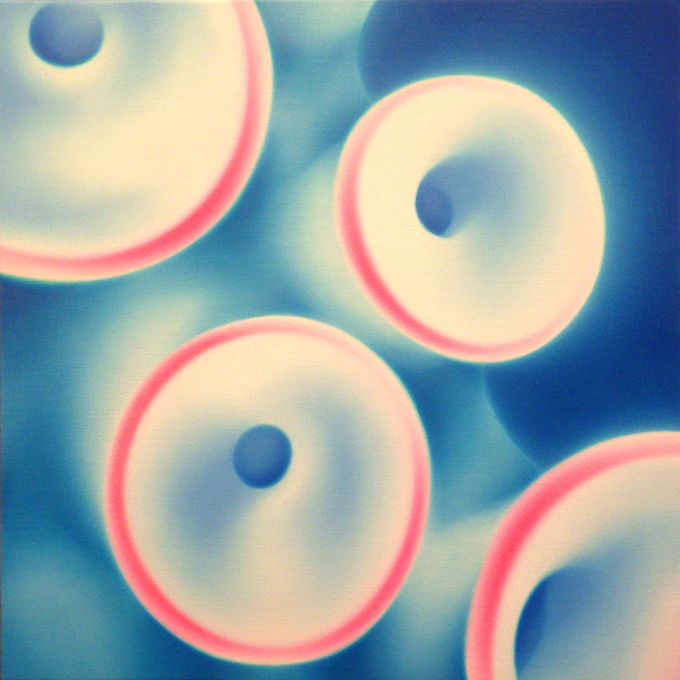
服部知佳 sugar mist 455x455 (S8)油彩、キャンバス 2026
服部は、日本の伝統的な襖絵や掛け軸に見られる独特の空間性に強く惹かれているといいます。彼女の作品には、描かれているものだけではなく、あえて描かれない余白があります。その余白は、画面の外へと続く空間や、そこに息づく見えない生命の存在までも観る者に想像させるのです。
Hattori has spoken of her deep admiration for the unique spatial sensibility found in traditional Japanese painting, particularly in fusuma-e (sliding-door paintings) and hanging scrolls. Her works invite viewers to imagine not only what is depicted, but also what lies beyond the frame. Through the deliberate use of empty space, they evoke unseen worlds and forms of life that continue beyond the visible image.
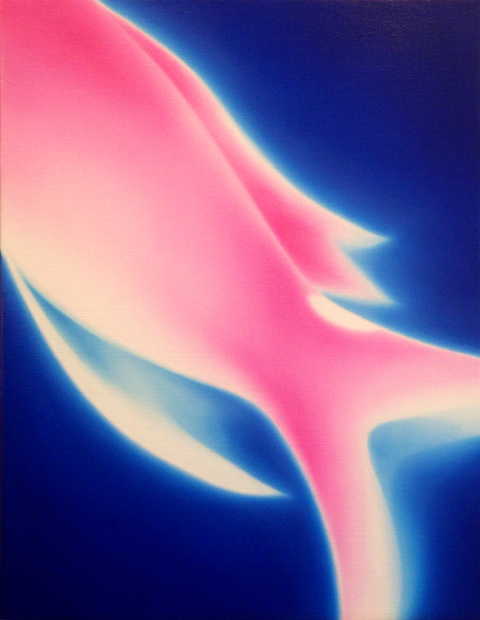
服部知佳 Rose 410x318 (F6)油彩、キャンバス 2025
服部知佳 Chika HATTORI
作品収載:
東京オペラシティアートギャラリー (東京) 群馬県立近代美術館(群馬) 、府中市美術館(東京) 、多摩美術大学美術館(東京)、村内ファニチャーアクセス(東京)
<受賞>
2004年 第6回高知国際版画トリエンナーレ 準大賞「山女」木版80x60cm


phone : 03-5542-1669 >> MAP
Open : Tue.-Sat. 12:00-19:00
Closed on Sun., Mon., National Holiday
Koura Bldg. Ⅰ-2B,
1-1-6,,Nihombashi Kayabacho, Chuoh-ku,Tokyo
103-0023, JAPAN phone : +81(0)3 5542 1669
e-mail : info@yuki-sis.com http://yuki-sis.com